
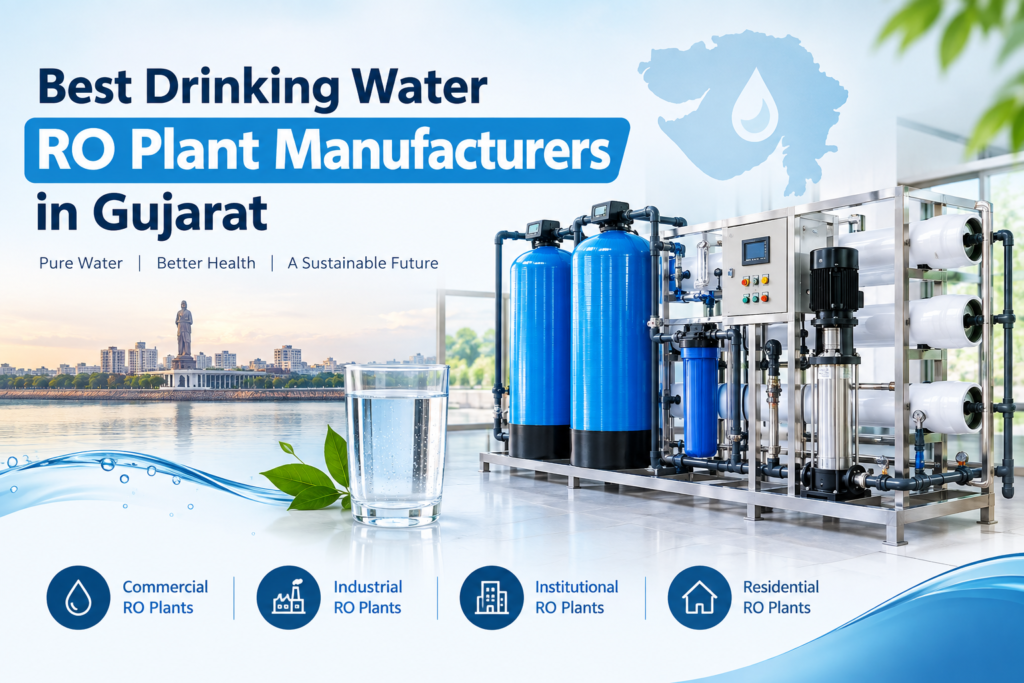
Best Drinking Water RO Plant Manufacturers in Gujarat
Clean and safe drinking water is essential for homes, businesses, industries, institutions, and communities. As water quality concerns continue to increase, reliable water purification systems have become an important requirement across Gujarat. Among the different purification technologies available today, RO (Reverse Osmosis) plants are widely used for treating water and reducing dissolved impurities.
Businesses looking for reliable water purification solutions often search for Best Drinking Water RO Plant Manufacturers in Gujarat to find manufacturers that can provide suitable RO systems based on their water source, capacity requirements, and application.
This guide explains what to consider when selecting a drinking water RO plant manufacturer in Gujarat, how RO plants work, their applications, and the key factors that can help you choose an appropriate system.
What Is a Drinking Water RO Plant?
A drinking water RO plant is a water purification system designed to treat water using Reverse Osmosis technology. In the RO process, water is passed through a semi-permeable membrane under pressure.
The membrane helps reduce various dissolved substances and contaminants from the feed water. Depending on the system design and water quality, an RO plant may be combined with additional treatment stages such as:
- Sand filtration
- Activated carbon filtration
- Micron filtration
- Antiscalant dosing
- Reverse osmosis
- UV or ozone treatment
- Mineral adjustment
- Storage and distribution
The exact configuration depends on the quality of the incoming water and the intended use of the treated water.
Why Choose a Drinking Water RO Plant in Gujarat?
Gujarat has a diverse range of water sources, including groundwater, municipal water, borewell water, and surface water. Water quality can vary significantly between locations.
In some areas, water may contain higher levels of:
- Total Dissolved Solids (TDS)
- Hardness
- Fluoride
- Chloride
- Sulphate
- Iron
- Other dissolved impurities
An appropriately designed RO system can help reduce many dissolved impurities and produce treated water suitable for its intended application.
This is why RO plants are used across residential, commercial, institutional, hospitality, and industrial applications throughout Gujarat.
How Does a Drinking Water RO Plant Work?
A typical drinking water RO plant uses multiple stages of treatment.
1. Pre-Treatment
The incoming water is first treated to remove suspended particles and protect downstream equipment. Depending on the feed water, this stage may include sand filters, carbon filters, and other filtration systems.
2. Micron Filtration
Micron filters can help remove smaller suspended particles before the water reaches the RO membrane.
3. High-Pressure Pump
A high-pressure pump supplies the pressure required for the RO membrane to operate effectively.
4. Reverse Osmosis Membrane
The pressurized water passes through the RO membrane. The membrane separates a portion of dissolved salts and other contaminants from the treated water.
5. Post-Treatment
Depending on the application, post-treatment may include UV sterilization, ozone treatment, mineral adjustment, or other processes.
6. Storage and Distribution
The treated water can then be stored in a suitable tank and supplied to the required point of use.
Applications of Drinking Water RO Plants
Drinking water RO plants can be used in many different environments across Gujarat.
Commercial Buildings
Offices, commercial complexes, and business facilities may require purified drinking water for employees, visitors, and customers.
Hotels and Restaurants
Hotels, restaurants, cafes, and catering businesses can use water purification systems to support their drinking water requirements.
Schools and Colleges
Educational institutions may install RO systems to provide treated drinking water for students and staff.
Hospitals and Healthcare Facilities
Healthcare facilities require appropriate water treatment solutions for different applications. The required treatment specifications depend on the particular use.
Residential Communities
Housing societies and residential complexes can use centralized RO plants to supply treated drinking water to residents.
Industrial Facilities
Factories and industrial facilities may require RO systems for drinking water as well as specific process-water applications.
How to Select the Best Drinking Water RO Plant Manufacturer in Gujarat?
Searching for the Best Drinking Water RO Plant Manufacturers in Gujarat is only the first step. The right manufacturer should be evaluated according to the specific water treatment requirement.
1. Check Manufacturing Experience
Look for a manufacturer with relevant experience in designing and supplying RO systems for applications similar to yours.
Experience can be particularly important when the project requires customized treatment capacity or multiple filtration stages.
2. Evaluate Water Testing and System Design
A good RO system should be designed according to the quality of the feed water.
Before selecting an RO plant, consider getting the source water tested for parameters such as:
- TDS
- pH
- Hardness
- Turbidity
- Chloride
- Fluoride
- Iron
- Sulphate
- Microbiological parameters
The test results can help determine the appropriate treatment configuration.
3. Consider Required Capacity
RO plants are available in different capacities. Your required capacity depends on daily water consumption and peak demand.
For example, a small commercial facility may need a relatively compact system, while a large institution, hotel, or industrial facility may require a higher-capacity plant.
4. Ask About Membrane and Component Quality
The performance of an RO plant depends on several components, including membranes, pumps, filters, control systems, pressure vessels, and storage arrangements.
Ask the manufacturer about the specifications and brands of major components before finalizing a system.
5. Look for Customized Solutions
Every water source is different. A manufacturer should be able to recommend a configuration based on your feed-water quality and required treated-water specifications rather than offering the same system for every application.
6. Consider After-Sales Support
RO plants require regular maintenance. Filters need replacement, membranes require monitoring, and pumps and other components may require servicing.
Therefore, after-sales service and availability of replacement parts are important considerations when choosing a manufacturer.
Benefits of Installing a Drinking Water RO Plant
A properly designed RO plant can provide several advantages.
Improved Water Quality
RO technology can significantly reduce dissolved salts and various impurities from water, depending on the feed-water characteristics and membrane configuration.
Suitable for Different Water Sources
RO systems can be designed for different feed-water conditions, including borewell and municipal water, subject to appropriate pre-treatment.
Scalable Capacity
RO plants can be designed for different capacities, making them suitable for small commercial requirements as well as larger facilities.
Consistent Treatment
An appropriately operated and maintained RO plant can provide a more consistent treated-water quality compared with relying solely on untreated source water.
Integration With Other Treatment Technologies
RO systems can be combined with filtration, UV, ozone, mineral dosing, and other treatment processes according to the application.
Drinking Water RO Plant Manufacturer vs. Supplier
When searching for RO plant manufacturers in Gujarat, it is useful to understand the difference between a manufacturer and a supplier.
A manufacturer generally focuses on designing, assembling, fabricating, or producing water treatment systems and may provide customized solutions.
A supplier or dealer may source equipment from different manufacturers and provide installation or distribution services.
Both can be useful depending on the project, but businesses with specific treatment requirements may benefit from working with a manufacturer capable of providing customized system design and technical support.
RO Plant Maintenance Requirements
Installing an RO plant is not the end of the water treatment process. Regular maintenance is important for reliable operation.
Typical maintenance activities may include:
- Cleaning or replacing pre-filters
- Monitoring RO membrane performance
- Checking operating pressure
- Inspecting pumps
- Monitoring TDS and other water parameters
- Cleaning storage tanks
- Checking pipelines and valves
- Sanitizing applicable components
- Replacing consumable components when required
The maintenance schedule depends on the feed-water quality, plant capacity, operating hours, and system design.
Factors Affecting the Cost of a Drinking Water RO Plant
The cost of an RO plant can vary considerably from one project to another.
Important factors include:
- Plant capacity
- Feed-water quality
- Required recovery rate
- Number of treatment stages
- RO membrane specifications
- Pump capacity
- Automation level
- Material of construction
- Storage capacity
- Installation requirements
- Additional UV or ozone systems
- Mineral dosing requirements
- Electrical and piping work
Therefore, it is better to evaluate an RO plant based on the complete system and long-term operating requirements rather than comparing manufacturers only on the initial purchase price.
Why Gujarat Businesses Need Reliable Water Treatment Solutions
Gujarat has a strong industrial and commercial ecosystem, with manufacturing units, hotels, educational institutions, hospitals, residential developments, and other organizations requiring dependable water treatment systems.
A professionally designed drinking water RO plant can help organizations manage their treated-water requirements while maintaining a structured purification process.
For large projects, manufacturers may also provide site assessment, water analysis, plant design, installation, commissioning, operator guidance, and maintenance support.
Questions to Ask an RO Plant Manufacturer
Before purchasing a drinking water RO plant, ask the manufacturer:
- What RO capacity is suitable for our daily requirement?
- Has the source water been tested?
- What pre-treatment is required?
- What membrane configuration will be used?
- What is the expected recovery rate?
- What are the power and water requirements?
- What maintenance will be required?
- How frequently should membranes and filters be replaced?
- Is installation included?
- What after-sales service is available?
- Are spare parts readily available?
- Can the system be customized according to our water quality?